How Do Rats Get in Your House?
Wondering how do rats get in your house? They slip through small exterior holes as…
ElliottAugust 28, 2026

The fastest way to tell a roof rat from a Norway rat is the tail: a roof rat’s tail is longer than its body, while a Norway rat’s tail is shorter than its body. That one detail, plus where you find them nesting, tells you which rat is in your home and how to get rid of it.
At Bigfoot Pest Management, we get this question from Olympia and South Sound homeowners almost every week, because both species live here. This guide walks you through the differences, the signs each one leaves behind, and what to do next.
Here is the quick comparison. Both rats are brown or gray, so color will not help you. Focus on size, tail, ears, and where you find them.
Feature | Roof Rat (Rattus rattus) | Norway Rat (Rattus norvegicus) |
|---|---|---|
Other names | Black rat, ship rat | Brown rat, sewer rat |
Body length | Slender, 6–8 inches | Stocky, 7–10 inches |
Tail | Longer than the body | Shorter than the body |
Ears and eyes | Large ears, large eyes | Small ears, small eyes |
Nose | Pointed | Blunt |
Droppings | About 1/2 inch, pointed ends | About 3/4 inch, blunt ends |
Where they nest | High: attics, rafters, trees | Low: burrows, crawlspaces, basements |
You can usually identify the rat without ever seeing it clearly, because each species leaves a different fingerprint around your home.
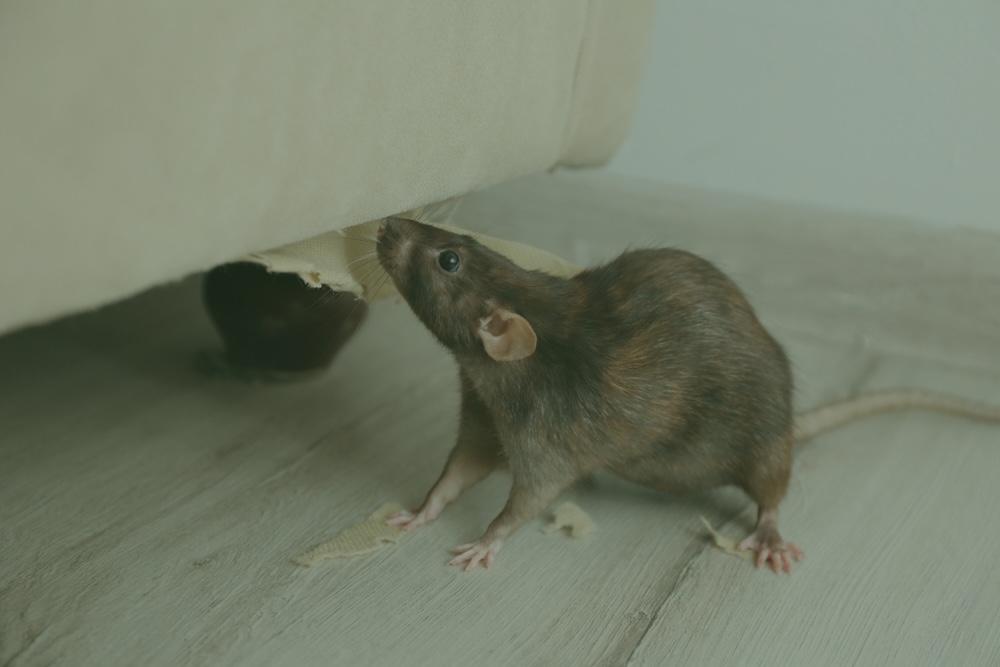
A roof rat is slim and agile with a pointed nose, large ears, and big eyes. Hold its tail against its body in your mind: if the tail reaches past the nose, it is a roof rat. A Norway rat is heavier and thicker through the middle, with small ears, small eyes, a blunt nose, and a tail that stops short of its body length.
Droppings are one of the most reliable clues. Roof rat droppings are about half an inch long with pointed ends. Norway rat droppings are larger, roughly three-quarters of an inch, with blunt, rounded ends.
Both rats gnaw constantly because their incisors never stop growing, so you may also find chew marks on wood, wiring, and food packaging.
Behavior is the giveaway. Roof rats climb and nest high, so think attics, rafters, wall voids, and the dense trees and ivy common across the Pacific Northwest.
Norway rats stay low and burrow, so think crawlspaces, under sheds, along foundations, and in the damp ground that South Sound winters create.

Both species are established in western Washington, so South Sound homeowners genuinely see both. Norway rats are widespread region-wide and thrive in our wet, mild winters, settling into crawlspaces and foundation burrows.
Roof rats favor the milder, saltwater-influenced Puget Sound climate and the mature trees around many Olympia, Lacey, and Tumwater neighborhoods, which give them the elevated routes they prefer.
If you are hearing scratching in the attic or ceiling, a roof rat is the likely culprit. If the noise and burrows are near ground level or in the crawlspace, suspect a Norway rat.
The Washington State Department of Health notes that rats can squeeze through a gap as small as a quarter inch when looking for entry points, which is why both species find their way into homes here.
Knowing the species tells you where to focus, because the two rats do not live in the same parts of your home. For roof rats, control means trapping and sealing up high: along rafters, roof lines, utility lines, and tree limbs that touch the house.
For Norway rats, control means working at ground level: bait stations and traps along foundations and runways, plus sealing crawlspace vents and gaps. Setting traps in the wrong zone is the most common reason a do-it-yourself effort fails.
Long-term success comes from exclusion, which means closing off the entry points so new rats cannot replace the ones you remove. Our team builds species identification into every professional rodent control plan so the traps and seals land where the rats actually travel.
Both rats can damage your home and carry disease, so neither should be ignored. They gnaw on electrical wiring, which is a fire risk, and they contaminate food and surfaces with droppings and urine.
Rats are associated with illnesses such as leptospirosis, salmonella, and rat-bite fever. One local note worth clearing up: hantavirus in Washington is carried by deer mice, not by roof rats or Norway rats, so finding rats does not mean a hantavirus exposure.
Even so, the hidden dangers of rodents go well beyond a single disease, and the safest approach is to remove them and clean up properly.
Most homeowners notice the evidence before they ever see a rat, so knowing the signs helps you catch an infestation early.
Watch for droppings along walls, in cabinets, or in the attic and garage. Listen for scratching or scurrying in the ceiling at night, which usually means roof rats overhead, or in the crawlspace and walls at floor level, which points to Norway rats.
Other common signs include gnaw marks on wood, wiring, and food packaging, greasy rub marks along baseboards and pipes where rats travel the same routes, a musky odor in enclosed spaces, and nests built from shredded paper, insulation, or fabric.
Outdoors, look for burrow holes near the foundation and well-worn runways through grass or mulch. Finding any one of these is reason to act, because a pair of rats can become a serious problem within a few months.
The most reliable way to stop rats long-term is to seal entry points and remove what attracts them, not just to trap the ones already inside. Start with exclusion: walk the exterior and seal gaps around pipes, vents, and the foundation, since both species can slip through openings as small as a quarter inch.
Cover crawlspace and attic vents with hardware cloth, and trim tree limbs and ivy back from the roof line to cut off the elevated routes that roof rats love. Next, remove the food and water that draws rats in. Store pet food and bird seed in sealed containers, keep garbage cans latched, pick up fallen fruit, and fix leaks or standing water that gives rats a drink.
Keep firewood and clutter away from the house, because woodpiles and debris make ideal Norway rat harborage. In our wet South Sound climate, crawlspaces stay damp and inviting through much of the year, so checking those seals each fall before the rainy season pays off.

How do I tell the difference between a roof rat and a Norway rat?
Check the tail and the nest location. A roof rat has a tail longer than its body, large ears, a pointed nose, and nests high in attics and trees. A Norway rat has a tail shorter than its body, small ears, a blunt nose, and nests low in burrows and crawlspaces.
What does a roof rat look like?
A roof rat is slender, 6 to 8 inches long in the body, brown to gray, with large ears, large eyes, a pointed snout, and a long, thin tail that extends past its body. It looks more delicate and agile than the bulkier Norway rat.
Are roof rats dangerous?
Yes. Roof rats can spread diseases such as leptospirosis and salmonella through their droppings and urine, and they gnaw on wiring that can create a fire hazard. They also nest in attics, where droppings can build up out of sight.
Where do Norway rats nest?
Norway rats nest low and dig. Outdoors, they burrow under sheds, woodpiles, and along foundations. Indoors, they favor crawlspaces, basements, and the lowest levels of a building. Burrow openings near the foundation are a classic Norway rat sign.
Why do I have rats in my home?
Rats come inside for food, water, and shelter, especially as South Sound weather turns cold and wet. Easy access to garbage, pet food, bird seed, fruit trees, and clutter draws them in, and gaps as small as a quarter inch let them through. Curious whether the noise is even a rat? Our tips for finding a nest fast can help you confirm.
Call a professional once you have seen droppings in more than one area, heard repeated activity in the attic or crawlspace, or found burrows along the foundation, because by then there is usually an active population rather than a single rat. A licensed technician identifies the species, finds the entry points you cannot see, and sets up trapping plus exclusion so the problem does not return.
Bigfoot Pest Management serves Olympia, Lacey, Tumwater, Yelm, Centralia, Chehalis, and Shelton, and we use integrated pest management with least-toxic methods so your family and pets stay safe. If you are not sure what you are dealing with, a quick inspection settles it.
Identifying your rat is simpler than it sounds:
If you have spotted the signs, schedule a rodent inspection with Bigfoot Pest Management, and we will tell you exactly which rat you have and how to keep it out for good.