
Stopping Rodent Damage in Your Olympia Home
Rodent damage is the destruction rats and mice cause when they chew, nest, and burrow…
ElliottAugust 28, 2026

Wondering how do rats get in your house? They slip through small exterior holes as narrow as a quarter-inch around utility lines, vents, doors, roofs, and foundations
Once they find warmth, food, or shelter inside, they settle into crawlspaces, wall voids, and attics. At Bigfoot Pest Management, we inspect homes across Olympia and the South Sound every week and almost always trace the problem back to a handful of predictable openings.
This guide walks through exactly where rats get in, why they picked your home, and how to seal the gaps for good.
Rats get in by exploiting existing weak points in your home’s exterior, not by chewing through solid walls at random. A rat’s skull is the widest part of its body, so if its head fits through a gap, the rest follows.
That means an opening the size of a quarter, roughly a half inch, is all a rat needs.
They tend to enter along three routes: low (foundation, crawlspace, and ground-level vents), high (roof edges, soffits, and attic vents, especially for climbing roof rats), and through service penetrations where pipes, wires, and drains pass into the house. Find those routes, and you know where to seal.
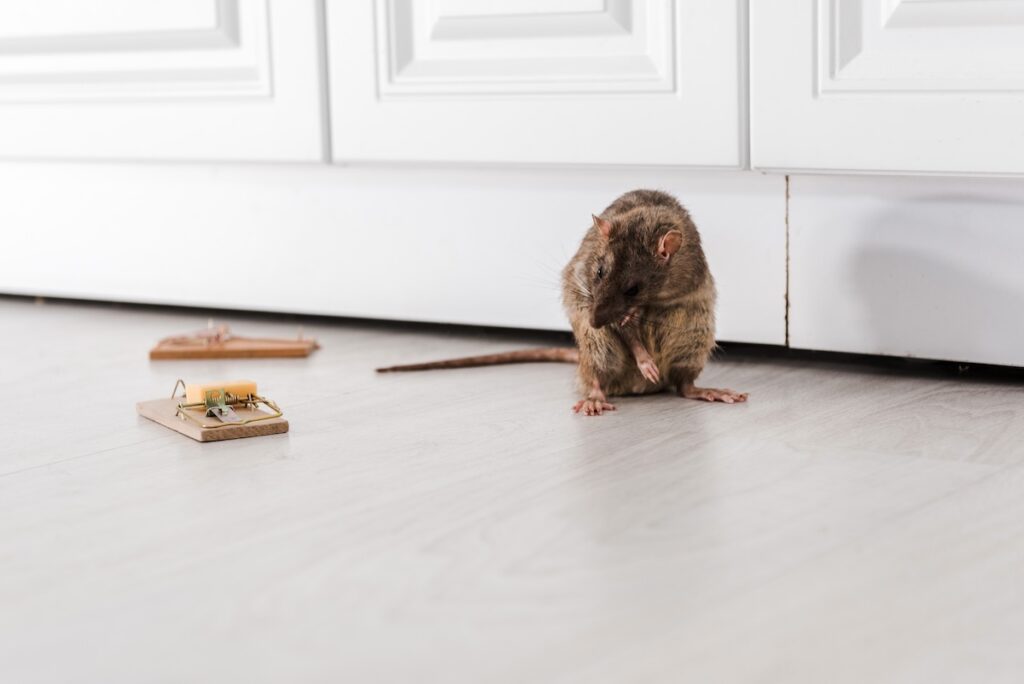
The most common rat entry points are foundation gaps, crawlspace and attic vents, roof and soffit openings, utility line penetrations, and poorly sealed doors. Here is where to look, from top to bottom.
Cracks in the foundation, gaps where the siding meets the slab, and damaged or uncovered crawlspace vents are prime ground-level entries. Norway rats in particular, burrow along foundations and slip in low.
Cover vents with quarter-inch hardware cloth and seal foundation cracks, since a gap you can slide two fingers into is more than enough.
How do rats get in your house? Roof rats climb, so your roofline is just as vulnerable as your foundation. They reach it by way of overhanging tree limbs, ivy, downspouts, and utility lines, then slip in through gaps in soffits, fascia, loose shingles, or uncapped attic and gable vents.
If you hear scratching in the ceiling at night, this is almost always the route.
Everywhere a pipe, gas line, electrical conduit, or cable enters your home, there is a drilled hole, and that hole is often larger than the pipe running through it.
The gap behind the stove where the gas or power line enters is one of the most common indoor rat holes there is. Stuff these gaps with steel wool or copper mesh and seal over them.
Worn weatherstripping, a garage door that does not seal flush at the corners, and gaps around window frames all give rats an easy way in.
Attached garages are a favorite because the internal garage-to-house door is often the weakest seal in the whole home. Add door sweeps and a garage threshold seal.
Rats are strong swimmers, and Norway rats especially will travel through sewer pipes and can come up through a floor drain or a damaged, uncapped cleanout.
Broken or disconnected drain lines under the house give them a direct path into the crawlspace. If entry points above ground all look sealed, have the drains inspected.
Rats come inside for three things: food, water, and shelter. Your home offers all three, especially as South Sound weather turns cold and wet in the fall. How do rats get in your house?
Unsecured garbage, pet food, birdseed, fallen fruit, and crumbs supply the food.
Leaky faucets, pet bowls, and standing water supply the drink. Cluttered garages, woodpiles against the house, and dense landscaping supply the shelter and the cover they use to reach your walls unseen.
Removing those attractants matters as much as sealing gaps. If you seal the holes but leave a buffet on the back porch, rats will work hard to find a new way in.
To find rat entry points and answer how do rats get in your house, walk your home’s full exterior from the foundation to the roofline and look for gaps, gnaw marks, and greasy rub marks where rats travel the same routes.
Pay closest attention to vents, pipe penetrations, the roofline, and anywhere you have heard noise.
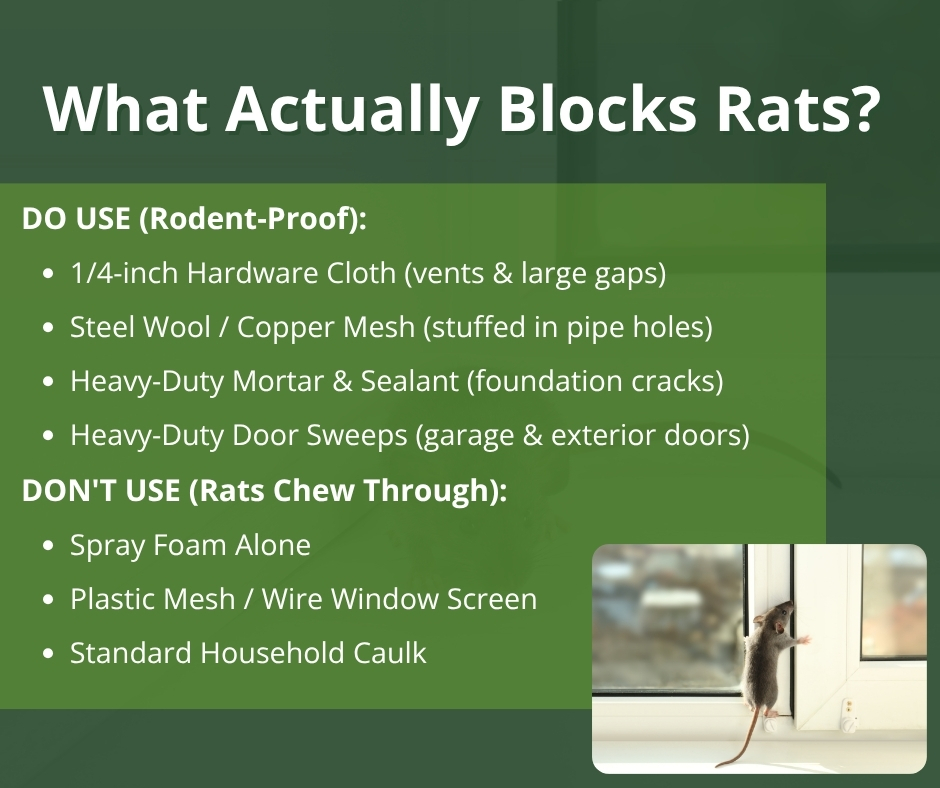
Seal what you find with rodent-resistant materials, not spray foam alone, which rats chew straight through:
Work from the roof down and the foundation up, and do not forget the penetrations behind appliances. Seal the building first, then trap any rats left inside, because trapping without sealing just makes room for the next rat.
In Olympia and the surrounding South Sound, two things make rat entry especially common: our wet, mild winters and our mature tree cover.
How do rats get in your house? Damp crawlspaces stay inviting to Norway rats through much of the year, and the tall firs, cedars, and ivy around many Olympia, Lacey, and Tumwater neighborhoods give roof rats the elevated highways they love.
That is why we tell local homeowners to check crawlspace vents and seals each fall before the rainy season, and to trim tree limbs and ivy back from the roofline.
Both species are established here, so a thorough inspection looks high and low, not just at ground level.
How small a gap can a rat fit through?
A rat can squeeze through a gap about a quarter inch wide, roughly the size of a quarter coin. The Washington State Department of Health notes that rats can enter through openings that small, because a rat can flatten its body and its skull is the only real limit. That is why sealing even minor-looking gaps matters.
What attracts rats to your house?
Food, water, and shelter answer the question how do rats get in your house. Unsecured garbage, pet food, bird seed, fallen fruit, leaky faucets, and cluttered garages or woodpiles all draw rats in. Curious which rat you are dealing with? Our guide to telling a roof rat from a Norway rat can help you narrow it down by where you are seeing signs.
How do rats Get in your house and where rats are getting in?
Walk the exterior from foundation to roof and look for gaps, gnaw marks, and dark, greasy rub marks along their travel routes. Follow the noise: scratching in the ceiling points to roof entries, while sounds at floor level point to foundation or crawlspace gaps.
Can rats come up through toilets or drains?
Yes. Rats are capable swimmers and can travel through sewer lines, occasionally surfacing through a toilet or coming up a damaged floor drain or cleanout. It is not the most common entry, but if your above-ground gaps are sealed and rats keep appearing, have the drain lines checked.
What is the best material to block rat entry points?
Quarter-inch hardware cloth, steel wool or copper mesh, and mortar or heavy-duty sealant. Rats chew through spray foam, plastic, and loose caulk, so those materials work only when backed by metal. Our exclusion and repairs team uses these same materials to seal homes for good.
Call a professional once you have found droppings or gnaw marks in more than one area, heard repeated activity in the attic or crawlspace, or sealed the obvious gaps and rats keep getting in.
By that point, there is usually an active population and at least one entry point you cannot see. A licensed technician inspects the whole structure, finds the hidden openings, and combines sealing with trapping so the problem does not come back.
Bigfoot Pest Management serves Olympia, Lacey, Tumwater, Yelm, Centralia, Chehalis, and Shelton, and we use integrated pest management with least-toxic methods, so your family and pets stay safe.
Our rodent control and exclusion work is built around finding entry points first, then keeping rats out for good.
Rats are easier to keep out than to evict once they are in:
If you have spotted the signs or want your home sealed before rat season, schedule an exclusion inspection with Bigfoot Pest Management, and we will find the entry points and close them for good.