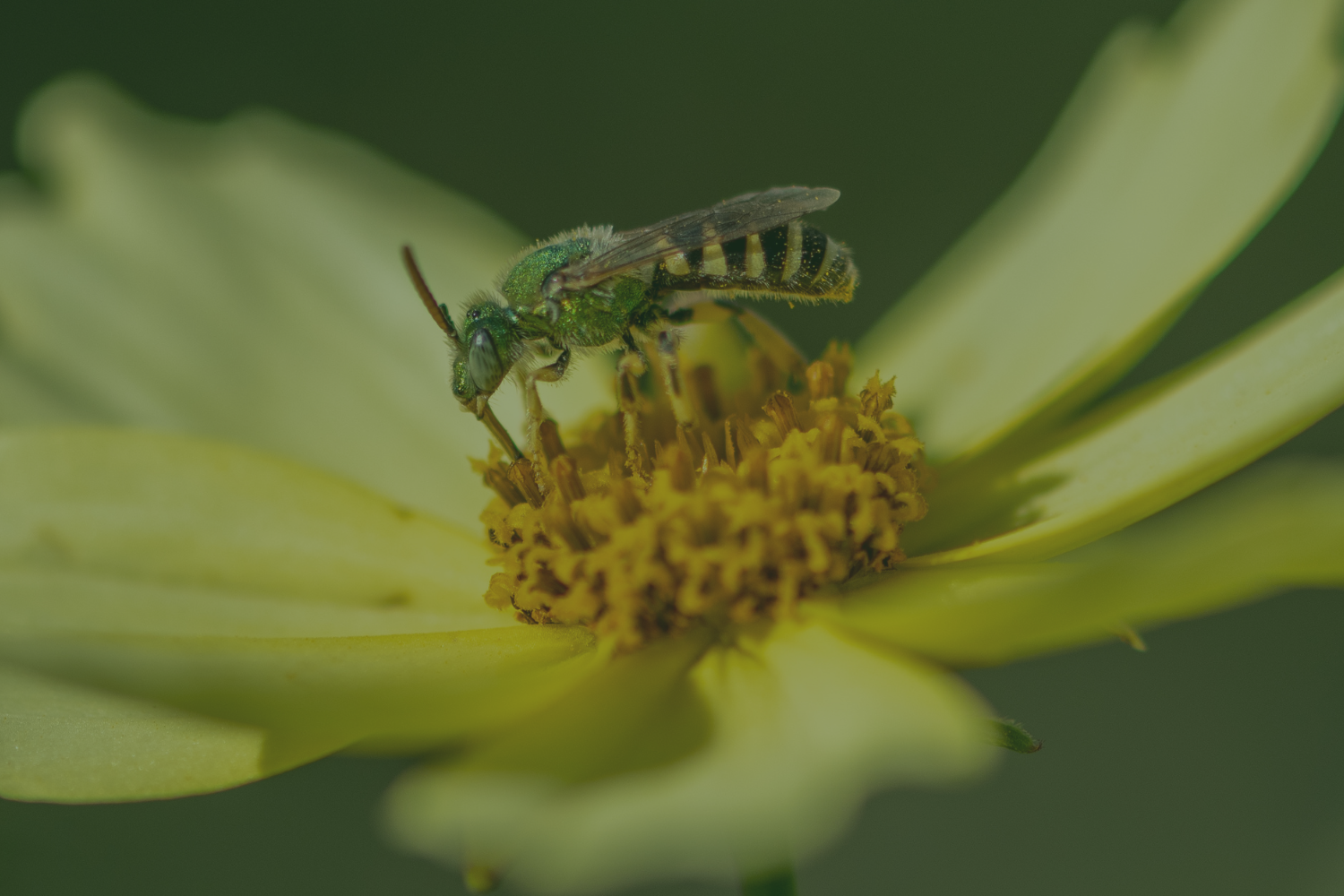
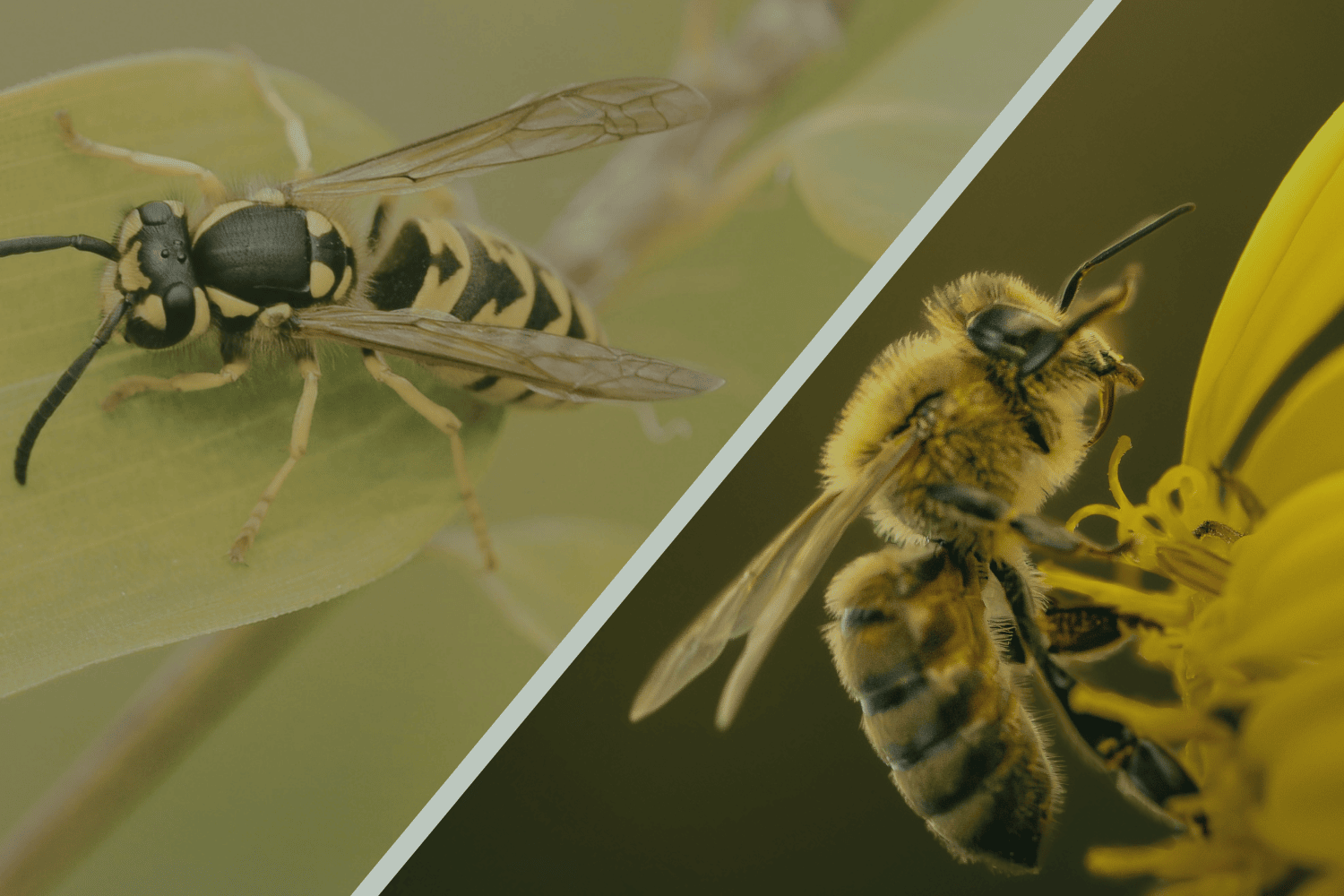
Honey Bee vs Yellow Jacket
If you have noticed stinging insects flying around your yard in Olympia, you are not…
ElliottFebruary 11, 2026

Several wasp species are common in Western Washington and Oregon, and they are not all the same level of threat. If something is buzzing around your eaves or nesting in your yard this summer, knowing what you are dealing with is the first step to knowing what to do.
This guide covers the wasps Olympia-area homeowners are most likely to encounter, what each one looks like, where it nests, and how aggressive it tends to be.
Wasps and bees both belong to the order Hymenoptera, but they are easy to tell apart once you know what to look for. Wasps have smooth, shiny bodies, a narrow, thread-like waist, and can sting multiple times. Bees are fuzzy, carry pollen, and leave their stinger behind when they sting you.
As for hornets, they are a type of wasp. All hornets are wasps, but not all wasps are hornets. The bald-faced hornet you see in the PNW is technically a yellow jacket, not a true hornet. There is only one true hornet in North America (the European hornet, Vespa crabro), and it is rare in Western Washington.
Feature | Wasp | Honey Bee |
|---|---|---|
Body | Smooth, shiny | Fuzzy |
Waist | Narrow, pinched | Wider, less defined |
Stinging | Can sting multiple times | Stings once, then dies |
Diet | Protein and nectar | Pollen and nectar |
Typical aggression | Varies by species | Generally lower |
If you are trying to sort out whether you have bees or yellow jackets, our post on honey bees vs. yellow jackets in your yard walks through the differences in more detail.

Here is a rundown of the wasp species you are most likely to encounter in the South Puget Sound area.
Yellow jackets are the most common stinging pest problem in Western Washington. Several species are found in the region:
Despite the name, bald-faced hornets (Dolichovespula maculata) are yellow jackets, not true hornets. They are larger than standard yellow jackets (about three-quarters of an inch long) and have a distinctive black-and-white coloring.
Their nests are hard to miss: gray, papery footballs hanging from tree branches or under eaves, often 1 to 3 feet long. A single nest can hold up to 700 workers by mid-summer. They are highly defensive. Do not approach an active nest.
The European paper wasp (Polistes dominula) arrived in North America in the 1970s and has spread throughout most PNW cities. It is now more common in Olympia-area suburbs than the native paper wasp species.
European paper wasps look a lot like yellow jackets (mostly yellow and black), but with a longer, more slender body and dangling legs when they fly. Their nests are the classic open-cell umbrella shape: a small circular comb hanging from a single stalk under an eave, in a window frame, or in a dense shrub.
Paper wasp colonies are smaller than yellow jacket colonies (typically 20 to 75 workers). They will defend the nest if you get close, but they are not prone to chasing people the way yellow jackets are.
Washington and Oregon also have native paper wasp species, including Polistes aurifer and Polistes fuscatus. These look different from the European species: brownish-red coloring with yellow markings rather than the brighter yellow-and-black pattern.
Native paper wasps have been declining in urban PNW areas as the European paper wasp has taken over their niche. You are more likely to see them in rural or forested areas of Lewis and Mason counties than in Olympia neighborhoods.
Mud daubers are solitary wasps. No colony, no workers, no queen to defend. A single female builds a nest made of mud cells (often on concrete walls, under porches, or in garages) and stocks each cell with paralyzed spiders for her larvae to eat.
Mud daubers almost never sting. They are not aggressive and do not defend a territory. If you see a cluster of small clay tubes on your siding, it is cosmetically annoying but not a health hazard.
Two species are common in the PNW: the black-and-yellow mud dauber (Sceliphron caementarium) and the blue mud dauber (Chalybion californicum).
Mud daubers are technically beneficial because they control spider populations. Removal is optional unless the nests are in a high-traffic area.
Wasp colonies in Western Washington follow a predictable seasonal pattern:
The last two weeks of August through mid-September are when Bigfoot Pest Management gets the most stinging-insect calls in Thurston County. It is also when outdoor events like Labor Day gatherings, late-season hikes, and yard cleanups bring people into close proximity with nests. Per WSU Extension’s guide to common PNW wasps, yellow jacket populations peak in late summer across the Pacific Northwest.
Social wasps (yellow jackets, bald-faced hornets, paper wasps) live in colonies with a queen and workers. They defend the nest. If you disturb a colony, even accidentally, a single worker’s alarm pheromone can recruit dozens or hundreds of nestmates to respond.
Solitary wasps (mud daubers, cicada killers, spider wasps) live and nest alone. There is no colony to defend. They rarely sting, and when they do, it is almost always because they were physically handled.
The practical takeaway: the bigger the colony, the higher the risk. An underground yellow jacket nest in late August is far more dangerous than a paper wasp nest under your eaves. A mud dauber tube on your garage wall is essentially harmless.

Washington state had confirmed detections of northern giant hornets (Vespa mandarinia) starting in 2019, primarily near the Canadian border in Whatcom County. The Washington State Department of Agriculture ran a multi-year eradication program. The last known nest was destroyed in 2021, and no established population has been confirmed since.
For Olympia-area homeowners: if you see a large wasp this summer, it is almost certainly a bald-faced hornet or a large yellow jacket. Northern giant hornets are over 1.5 inches long (two to three times the size of a yellow jacket) with an orange-and-black banded abdomen. If you genuinely believe you have seen one, report it to the WSDA at agr.wa.gov, but the odds for South Sound residents are extremely low.
How do yellow jackets end up nesting underground?
Most underground yellow jacket nests are built inside abandoned rodent burrows or soil cavities. Because these hidden colonies are highly dangerous to disturb, keeping a clear yard and staying on top of seasonal rodent control can significantly reduce the chances of wasps taking over old tunnels.
What do mud daubers eat, and are they dangerous?
Mud daubers are solitary, non-aggressive wasps that pose very little threat to humans. They spend their time hunting spiders to feed their larvae. While they act as a natural form of spider control, an influx of mud daubers usually indicates an abundant spider population on your property that may require targeted treatment.
When are stinging insects most active in Washington?
Wasp and yellow jacket activity peaks between late July and mid-September when colonies reach maximum size, and workers become aggressive scavengers. This late-summer surge often coincides with seasonal shifts in other household pests, making a proactive pest prevention plan the best way to protect your home year-round.
What is the difference between a wasp, a hornet, and a yellow jacket?
Hornets and yellow jackets are simply specific sub-categories under the broader wasp family. They are typically grouped together under professional stinging insect control because of their social nesting habits and highly defensive behavior, though each species requires a slightly different approach for safe removal.
Why do wasps and ants become more disruptive in late summer?
As temperatures peak, both wasps and various nuisance ant species experience dietary shifts, moving away from proteins and actively searching for sweet carbohydrates. This is why yellow jackets frequently crash outdoor barbecues at the exact same time that trailing ants begin invading kitchens in search of accessible food sources
Some wasp situations are manageable without professional help. A paper wasp nest under an eave with fewer than 10 workers can often be knocked down at dusk with a wasp freeze spray. A lone mud dauber nest on the garage wall needs nothing more than a putty knife.
But call a professional when:
Bigfoot’s stinging insect control services cover wasp and yellow jacket removal throughout Olympia, Lacey, Tumwater, Yelm, Centralia, and the surrounding Thurston County communities.
We identify the species, treat the colony, and check for entry points that could mean a nest inside your walls.
The Pacific Northwest has a lot of wasps, but they are not all the same. Yellow jackets, especially underground-nesting species, are the ones most homeowners need to worry about, particularly from August through September.
Paper wasps are common and worth watching but far less aggressive. Mud daubers are mostly harmless.
Key takeaways:
If you have a nest you are not sure about, or one that is too close to foot traffic to leave alone, we are here to help. Contact us to schedule a stinging insect inspection and Bigfoot will identify what you have and take care of it safely.