
Bigfoot Pest Management Has You Covered!
Olympia Pest Control: Bigfoot Pest Management Hello, Olympia and Lacey residents! Are pests making themselves…
Jenny TuckerApril 24, 2024

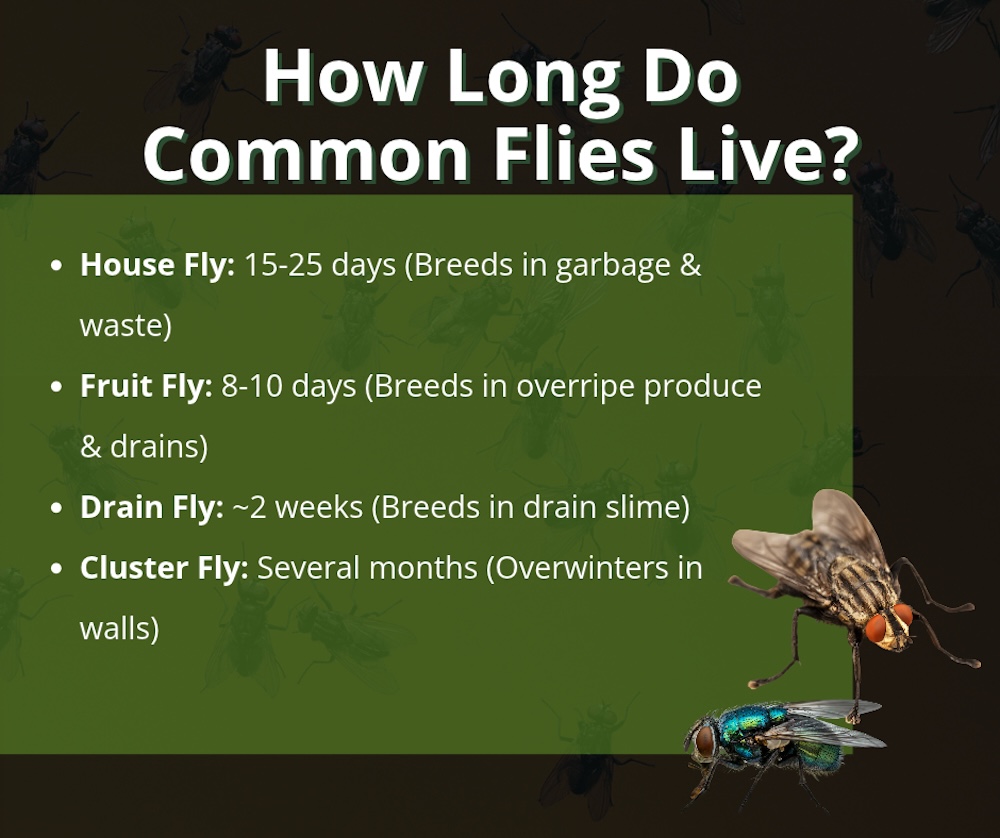
Most house flies live about 15 to 25 days as adults, and a few make it to two months. The whole trip from egg to adult can take as little as a week in warm weather.
That short life is why one stray fly in your Olympia kitchen can turn into dozens before you know it. At Bigfoot Pest Management, we get this question a lot, usually from someone hoping the flies will just die off on their own.
Sometimes they will. Often they won’t, because each fly leaves hundreds of eggs behind. Below, we cover lifespans by fly type, the four life stages, how weather changes the clock, and how to break the cycle in a South Sound home.
A fly’s lifespan depends on its species. Adult house flies usually live 2 to 4 weeks, drain flies about 2 weeks, and cluster flies can survive for months while they wait out winter inside your walls.
Here is a quick comparison of the flies Washington homeowners see most.
| Fly type | Adult lifespan | Egg to adult | Where it breeds |
|---|---|---|---|
| House fly | 15 to 25 days, up to about 2 months | 7 to 10 days when warm, up to 2 months when cool | Garbage, pet waste, compost, manure |
| Fruit fly | Varies widely with temperature | About 8 to 10 days | Overripe produce, drains, recycling bins |
| Drain (moth) fly | About 2 weeks | 1 to 3 weeks | Slime inside drains and sewer lines |
| Blow fly (bottle fly) | Varies; not well documented | As little as 7 days | Garbage, dead animals, meat scraps |
| Cluster fly | Months for adults that overwinter | Several weeks | Outdoors, inside earthworms in lawns |
Keep two numbers in mind when you read any fly lifespan claim. “Adult lifespan” means the time a fly spends buzzing around. “Life cycle” means the full trip from egg to adult.
Mixing them up is why you see such different answers online.
Flies go through complete metamorphosis, which means four stages: egg, larva, pupa, and adult. For a house fly, the egg and larval stages are where most of the time goes, and warm weather speeds every stage up.
According to the University of Florida’s house fly profile, here is how each stage plays out.
A female house fly lays her eggs in batches of about 75 to 150, right on moist, rotting material. The eggs are white and only about 1 millimeter long, and they hatch fast, usually within a day.
The larvae are the maggots you may spot in a garbage can lid. They eat and grow, molting as they go. In ideal warm conditions, this stage lasts 4 to 13 days. In cooler weather around 53 to 63°F, it can stretch to 14 to 30 days.
Yes, maggots turn into flies. This is the stage to target, because maggots can’t leave the spot where they hatched.
Mature larvae crawl to a drier spot and form a hard brown case called a puparium. Inside, the body rebuilds into an adult. In hot weather, this takes 2 to 6 days. Near 57°F, it can take 17 to 27 days.
The adult fly pushes out of its case, dries its wings, and starts looking for food. Females can begin laying eggs within a few days. They keep laying for the rest of their lives, which is the real problem.
Heat makes flies grow up faster and breed more, while cool weather slows everything down. A house fly can go from egg to adult in about a week at summer temperatures, but the same trip can take two months when it’s chilly.
That matters here in western Washington. Our mild, cool weather means house flies build up more slowly than they do in hot states. Then a warm stretch in July or August hits, and populations jump.
In temperate areas, house flies can produce 10 to 12 generations in a single year. Flies don’t die off completely in winter, either. They ride it out as larvae or pupae in sheltered spots like compost piles and barns, then finish growing when spring warms things up.
A single house fly trapped inside with no food or water usually dies within 2 to 3 days. With access to food, crumbs, and a little moisture, an indoor fly can live its full 2 to 4 weeks.
The bigger question is whether it has somewhere to lay eggs.
If you keep seeing flies indoors for more than a week or two, something inside or right outside is feeding the next generation.
Common sources include:
Fruit flies, drain flies, and fungus gnats are the usual suspects when the flies are tiny. Our guide on getting rid of fruit flies fast walks through traps and cleaning steps that work.
A single female house fly can lay up to 500 eggs over her short life. With a new generation possible every week or two in warm weather, a couple of flies in June can mean a full infestation by August. That’s why waiting for flies to die of old age rarely works. The adults do die, but their offspring are already on the way.
Lifespans across household pests vary a lot. A fly’s life is measured in days and weeks, while larger pests like squirrels live for years (here’s a look at how long squirrels live). Short-lived pests make up for it with numbers.
Flies win because they reproduce fast, not because they live long.
Most outdoor flies slow down and die off as fall turns cold, but their eggs, larvae, and pupae survive to restart the cycle in spring. The fly you notice indoors in October or November is often a different kind: the cluster fly.
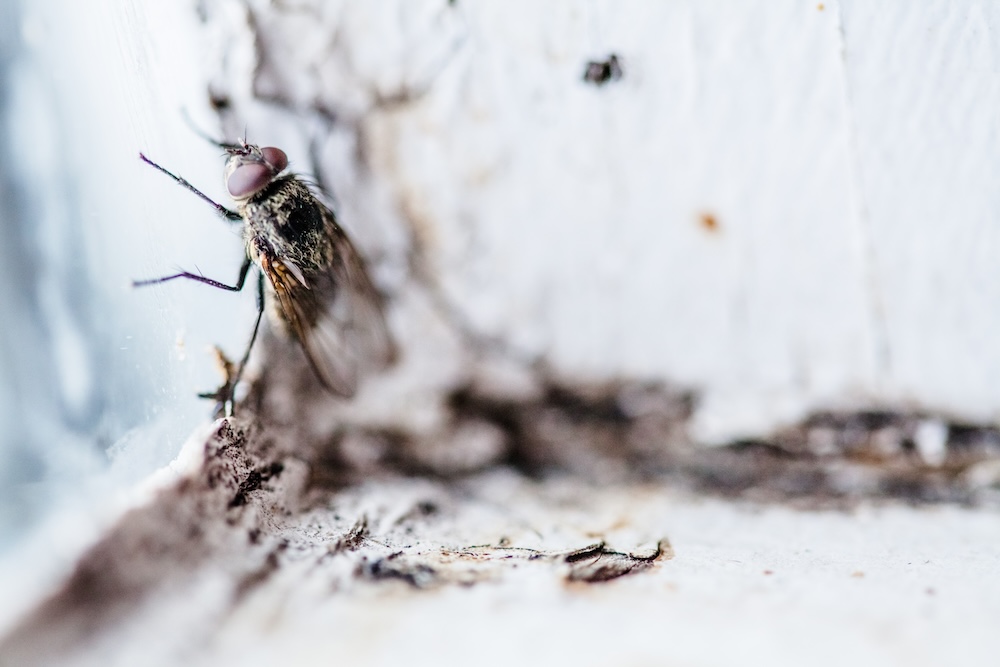
Cluster flies look like slightly larger, slower house flies with golden hairs on their backs.
Their larvae live as parasites inside earthworms, so lawns west of the Cascades suit them well. In early fall, adults gather on sunny south and west walls, then crawl through small gaps into attics and wall voids for the winter.
According to Washington State University’s cluster fly fact sheet, they don’t breed indoors. On warm winter and spring days, they wander out and bump around windows, often in rooms you rarely use.
Because they spend the winter resting, cluster flies outlive house flies by a wide margin. Adults that move in during September can still be around in April.
Killing the ones at the window won’t stop next year’s group, since the problem is how they’re getting in.
The fastest way to shorten a fly problem is to take away the places they lay eggs. Adults only live a few weeks, so if no new generation hatches, the problem fades on its own. Work through these steps:
Sticky traps and fly swatters help with the adults you already have. They won’t fix the source, so pair them with the cleanup steps above.
Do flies really only live for 24 hours?
No. The 24-hour myth comes from mayflies, which aren’t true flies. Adult mayflies often live only about a day. House flies live weeks. Many winged insects get mistaken for flies, from mayflies to roaches (if you’ve wondered whether cockroaches can fly, the answer depends on the species).
How long can a fly live without food?
A house fly usually survives only 2 to 3 days without food, and less without water. That’s why a single fly trapped in a closed room often dies quickly, while flies in a kitchen with open trash can live their full lifespan.
Where do flies go in the winter?
House flies spend winter as larvae or pupae in sheltered, warm spots like manure, compost, and barns. Cluster flies spend it as adults inside attics and wall voids. Read more in our homeowner’s guide to winter pests.
Where do flies come from?
Indoor flies come from eggs laid in rotting food, garbage, drains, or pet waste, or they fly in through open doors and torn screens. If flies keep showing up, there’s usually a breeding site within a few feet of where you see them.
Do maggots turn into flies?
Yes. Maggots are fly larvae. After feeding for several days to a few weeks, they form a hard case, then come out as adult flies. Finding maggots means adult flies are only days away.
How long do fruit flies live?
Fruit flies can go from egg to adult in about 8 to 10 days in a warm kitchen. Females lay up to 500 eggs, so the population builds fast if produce or drain buildup gives them a place to breed.
Are biting flies the same as house flies?
No. Horse flies, deer flies, and other biting flies breed near water and feed on blood. House flies don’t bite. Our post on biting flies in Olympia covers those summer pests.
For most house flies and fruit flies, you don’t need an exterminator. Cleaning out the breeding site is the real fix, and a quarterly spray won’t stop a fly hatching from a dirty trash can.
Elliott Hahn started Bigfoot Pest Management in 2021 with one simple rule: don’t sell people something they don’t need. Flies are a good example.
There are a few times when a fly problem points to something bigger:
We serve Olympia, Lacey, Tumwater, Yelm, and nearby South Sound communities, and Elliott still handles new-customer inspections himself.
Flies don’t live long, but they make up for it with speed and numbers. Here are the key takeaways:
If flies are pointing to rodents or a gap in your home’s exterior, contact Bigfoot Pest Management for an honest inspection.


